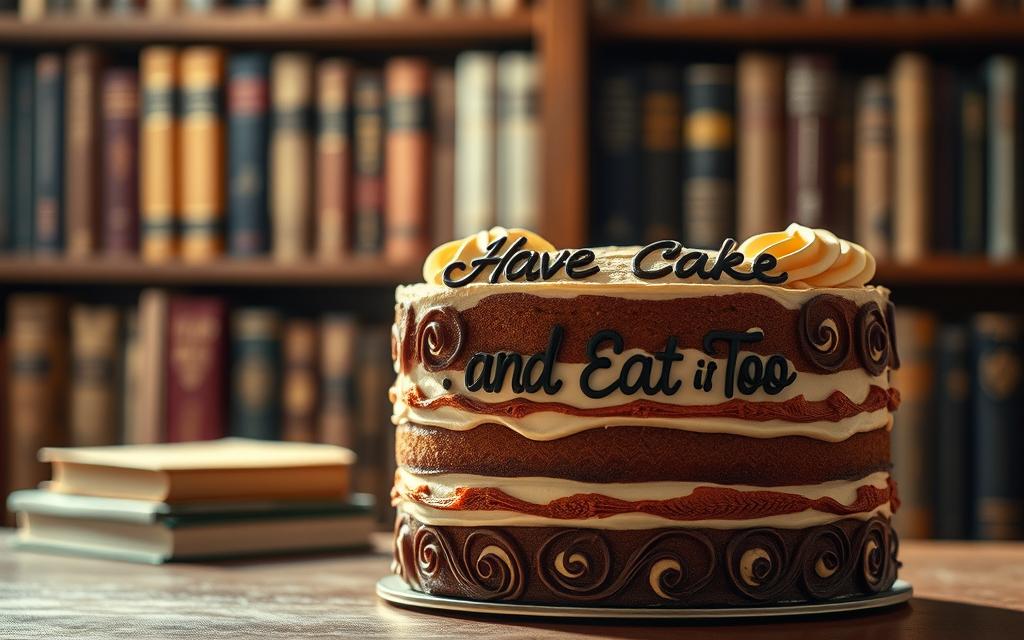
The phrase “you can’t have your cake and eat it too” is a popular English idiom that has been in use since the 16th century. At its core, this proverb literally means that you cannot simultaneously retain possession of a cake and consume it.
This expression is used to convey that one cannot have two incompatible things or have more than is reasonable. The originalform of the phrase has evolved over time, leading to its current usage in various contexts, from personal choices to political discourse, where it has spawned terms like “cakeism.”
The sense of this proverb is similar to other phrases like “you can’t have it both ways” and “you can’t have the best of both worlds.” Understanding its meaning and origin can provide insight into its enduring relevance.
Delving into the significance of “you can’t have your cake and eat it too” reveals the intricate dynamics of choice and consequence. This proverb, at its core, communicates a simple yet profound message about the nature of decisions and their outcomes.
What Does “Can’t Have Cake and Eat it Too” Actually Mean?
The phrase essentially means that you cannot enjoy two mutually exclusive things simultaneously. Choosing between having and eating a cake illustrates the concept of trade-offs or opportunity cost. In other words, if you eat the cake, you can’t have it anymore; it’s consumed. This idiom is used to convey that some choices are mutually exclusive, and making one choice means giving up another.
“You can’t have your cake and eat it too” is often quoted to highlight the logic behind decision-making. It emphasizes that certain things in life are not possible to have simultaneously, and one must make a choice.
The concept of mutually exclusive choices is fundamental to understanding the proverb. It refers to situations where choosing one option precludes the possibility of choosing another. This concept is crucial in economics, where it’s related to the idea of opportunity cost – the value of the next best alternative given up as a result of making a decision.
Recognizing mutually exclusive options is essential for rational decision-making and setting realistic expectations. It applies across various domains of life, from personal relationships to business decisions and political policies. By understanding that some things are incompatible, individuals can make more informed choices.
In conclusion, “you can’t have your cake and eat it too” is a saying that encapsulates the idea that some choices are mutually exclusive. It encourages a deeper understanding of the trade-offs involved in decision-making.
Historical Origins of the Phrase
Delving into the past, we find that the phrase “You Can’t Have Cake and Eat it Too” emerged in the 16th century, reflecting the cultural and social nuances of the time. This period was significant for the English language, as it was a time when many proverbs and idioms were first recorded in written form.
https://www.youtube.com/watch?v=JNxhvchHxY8
First Recorded Uses in the 16th Century
The first recorded uses of this phrase date back to the 16th century. One of the earliest written records is found in John Heywood’s A dialogue Conteinyng the Nomber in Effect of All the Prouerbes in the Englishe Tongue from 1546. Heywood’s work is significant not only because it includes this famous cake expression but also because it is one of the earliest collections of English proverbs.
In Heywood’s dialogue, the phrase appears as “wolde you bothe eate your cake, and have your cake?” This version shows a reversed clause order compared to later versions. The original form of the proverb highlights the evolving nature of language and how expressions change over time.
John Heywood’s Dialogue and Early Variations
John Heywood’s contribution to documenting English proverbs, including “You Can’t Have Cake and Eat it Too,” is invaluable. His work helped preserve and popularize these expressions, making them accessible to a wider audience. Other early variations of the proverb, such as John Davies’s 1611 version in Scourge of Folly, show how the phrase evolved. Davies wrote, “A man cannot eat his cake and haue it stil,” illustrating a different word order.
Author
Year
Version of the Proverb
John Heywood
1546
“wolde you bothe eate your cake, and have your cake?”
John Davies
1611
“A man cannot eat his cake and haue it stil”
The different versions of the proverb reveal how its meaning and form have been interpreted over time. The variations in wording reflect the dynamic nature of language and the cultural context in which these expressions were used.
Evolution of the Phrase Through Time
The evolution of the phrase ‘you can’t have your cake and eat it too’ is a fascinating story that reflects changes in language and culture. This idiom has been a part of the English language for centuries, and its transformation over time is a testament to its enduring relevance.
From “Eat-Have” to “Have-Eat” Order
One of the most notable changes in the phrase’s evolution is the shift from the original “eat-have” order to the more commonly used “have-eat” order today. Historically, the phrase was first recorded in the 16th century with the “eat-have” sequence. However, over time, the order was reversed, and by the 19th century, “have-eat” had become the dominant form. For instance, Ayn Rand’s 1957 novel Atlas Shrugged used the “have-eat” variant three times, illustrating its acceptance in literary circles.
How the Phrase Entered Common Language
The transition of the phrase into everyday speech can be attributed to its use in various forms of media and literature. As the expression appeared in books, films, and political speeches, it became more ingrained in popular culture. Different generations and demographic groups have understood and used the phrase in various ways, reflecting changing societal values. The phrase’s ability to adapt to different contexts has ensured its continued relevance in modern language. People from all walks of life use this phrase to convey the idea that you can’t enjoy two mutually exclusive things simultaneously.
In conclusion, the phrase “you can’t have your cake and eat it too” has evolved significantly over time, influenced by literary works, media, and cultural shifts. Its common form is now widely recognized and used, making it a staple of the English language.
The Logical Debate: Which Version Makes More Sense?
The debate surrounding the phrase “you can’t have your cake and eat it too” has sparked intense discussion about its logical consistency. At the heart of this debate is the question of whether the original “eat-have” order or the alternative “have-eat” order is more logical.
The Sequentiality vs. Simultaneity Argument
The argument centers on the sequentiality versus simultaneity of the actions involved in having and eating cake. Richard Mason countered Zimmer’s assertion that the two actions are mutually exclusive by arguing that having and eating cake are not simultaneous but rather sequential actions. Mason stated, “Generally, I cannot eat something at any time when I do not have it. But I eat things when I have them all the time.”
This perspective highlights the temporal logic that underlies the phrase. To eat cake, one must first have cake. Once the cake is consumed, it is no longer in one’s possession. This logical progression supports the “eat-have” order as being more intuitive.
Why Some Consider “Eat-Have” More Logical
Many language experts consider the “eat-have” order more logical because it follows the natural sequence of actions. You must possess the cake before you can eat it, and after eating, you no longer have it. This sequence is reflected in the table below, illustrating the logical flow of having and consuming cake.
Action
Status of Cake
Having cake
Cake is possessed
Eating cake
Cake is being consumed
Having eaten cake
Cake is no longer possessed
The debate over the logical consistency of the phrase “you can’t have your cake and eat it too” reflects broader issues in linguistics about how word order affects meaning and logic in expressions. While idiomatic expressions often defy literal interpretation, the discussion around this phrase highlights the importance of understanding the underlying logic and sequence of actions it implies.
Can’t Have Cake and Eat it Too: Cultural Significance
The phrase ‘Can’t Have Cake and Eat it Too’ is more than just a saying; it’s a reflection of life’s trade-offs. This idiom has become an integral part of our language, symbolizing the difficult choices we face in various aspects of life.
Trade-offs in Life
The idiom perfectly illustrates the concept of trade-offs or opportunity cost. Choosing between having and eating a cake is a simple yet effective metaphor for understanding that when we make a choice, we inherently give up something else. This concept is crucial in decision-making processes, whether personal or professional.
The proverb highlights the economic concept of opportunity cost, which is the value of the next best alternative given up when making a decision.
Economists and business strategists use this concept to analyze decision-making and resource allocation, making it a fundamental principle in economics.
Real-world examples of opportunity costs can be seen in business, policy, and personal finance, illustrating the practical application of this concept.
Representing Opportunity Cost
The idiom ‘Can’t Have Cake and Eat it Too’ represents opportunity cost by illustrating that consuming the cake (enjoying it) means you can’t have it intact (save it for later). This simple cake metaphor makes the complex concept of opportunity cost accessible to everyone, not just economists.
Understanding opportunity cost can lead to more intentional and strategic decision-making. By recognizing what is being given up with each choice, individuals and organizations can make more informed decisions that align with their goals and priorities.
Famous Uses in Literature and Media
Throughout history, ‘you can’t have your cake and eat it too’ has been utilized in different literary and media contexts. This phrase has been a powerful tool for authors and creators to convey the idea of making difficult choices and facing the consequences of one’s actions.
Jonathan Swift’s “Polite Conversation”
One of the earliest recorded uses of the phrase is found in Jonathan Swift’s 1738 work, “Polite Conversation.” Swift’s inclusion of the proverb in his satirical dialogue highlights its presence in everyday language during the 18th century. The use of the phrase in this context demonstrates its role in reflecting common societal values and the trade-offs people must make.
Ayn Rand’s “Atlas Shrugged”
Ayn Rand, in her novel “Atlas Shrugged,” employs the phrase to illustrate the concept of making choices and dealing with the consequences. The character’s use of the proverb underscores the theme of individual decision-making and the impossibility of having multiple mutually exclusive things simultaneously. Rand’s use of the phrase adds depth to her philosophical arguments about objectivism and the human condition.
The Unabomber Case: How the Phrase Helped Catch Ted Kaczynski
The phrase played a significant role in the FBI’s identification and capture of Ted Kaczynski, known as the Unabomber. In his manifesto, Kaczynski used the less common “eat-have” variant of the proverb, writing, “As for the negative consequences of eliminating industrial society — well, you can’t eat your cake and have it too.” FBI forensic linguist James R. Fitzgerald noticed this unusual variant and later found the same phrasing in letters to Kaczynski’s mother, which helped confirm his identity.
This case highlights the importance of linguistic analysis in forensic science. The use of the phrase, particularly the less common variant, served as a crucial clue in the investigation. It demonstrates how even seemingly innocuous phrases can become significant in the context of criminal investigations.
The Rise of “Cakeism” in Modern Politics
“Cakeism,” a concept derived from the proverb “you can’t have your cake and eat it too,” has gained traction in modern politics, especially during the UK’s Brexit deliberations. This phenomenon reflects a broader trend where politicians and negotiators seek to enjoy two desirable but incompatible alternatives.
Boris Johnson and Brexit Negotiations
Boris Johnson, the former Prime Minister of the UK, played a significant role in popularizing “cakeism” during Brexit negotiations. Johnson’s approach to Brexit embodied the essence of “cakeism” – wanting to leave the EU while maintaining the benefits of EU membership. This stance was seen as attempting to “have the cake and eat it too,” a phrase that was later adapted into “cakeism.”
Johnson’s negotiation strategy was criticized for being unrealistic, as it sought to reconcile two mutually exclusive outcomes. Critics argued that his approach was akin to wanting to eat cake while still having it, a notion that was seen as unfeasible.
How “Cakeism” Entered Political Discourse
The term “cakeism” quickly gained traction in political discourse and journalism as a way to describe not just Brexit negotiations but also other political positions that seemed to desire incompatible outcomes. It has been defined in political contexts as the wish to enjoy two desirable alternatives that are mutually exclusive.
“Cakeism” has been applied beyond Brexit to describe various political stances that appear to want contradictory things. For instance, political commentators have used the term to critique negotiating positions that seem unrealistic or contradictory. Economists and diplomats have also employed the term to highlight the challenges of achieving mutually exclusive goals.
The usage of “cakeism” raises questions about whether it represents a temporary political buzzword or a lasting addition to our political vocabulary. As political discourse continues to evolve, it remains to be seen how “cakeism” will be remembered and utilized in the future.
Common Misunderstandings About the Phrase
The phrase “you can’t have your cake and eat it too” has been a subject of debate, with many people misunderstanding its intended meaning. Understanding this idiom can be challenging due to the multiple meanings of the word “have.”
According to Paul Brians, Professor of English at Washington State University, the idiom confuses many people because the verb “to have” can refer to possessing, but also to eating, as in “Let’s have breakfast” or “I’m having a sandwich.”
Why the Idiom Confuses Many People
The multiple meanings of “have” in English create ambiguity in interpreting the proverb. This linguistic ambiguity affects both native and non-native English speakers’ understanding of the phrase. For instance, when we say “have cake,” it can mean either possessing the cake or consuming it.
This ambiguity is not unique to English. Many languages have similar proverbs that can be confusing due to the nuances of language. For example, the concept of “having” something can be interpreted differently across cultures.
The Role of the Word “Have” in Creating Ambiguity
The word “have” plays a crucial role in the ambiguity surrounding the idiom. As Professor Brians explained, “have” can mean both “possess” and “consume.” This dual meaning can lead to confusion about the phrase’s intended meaning.
To illustrate this point, let’s consider a comparison of how different languages express similar ideas:
Language
Proverb
Meaning
English
You can’t have your cake and eat it too
Can’t enjoy two mutually exclusive things
French
On ne peut pas avoir le beurre et l’argent du beurre
Can’t have the butter and the money from selling the butter
Spanish
No se puede tener la torta y comerla
Can’t have the cake and eat it
In conclusion, the phrase “you can’t have your cake and eat it too” is often misunderstood due to the ambiguity of the word “have.” By understanding the multiple meanings of “have” and how it affects the interpretation of the idiom, we can better appreciate the nuances of language and culture.
Similar Idioms and Expressions
Other expressions, such as “you can’t have it both ways” and “you can’t have the best of both worlds,” share a similar meaning with the “cake” idiom. These phrases all convey the idea of making choices between mutually exclusive options.
“You Can’t Have It Both Ways”
The phrase “you can’t have it both ways” is often used interchangeably with the “cake” idiom. It emphasizes the impossibility of enjoying two incompatible things simultaneously. For instance, one might say, “You can’t have it both ways; you need to choose between a beach vacation or a mountain retreat.” This expression is commonly used in discussions about lifestyle choices, relationship compromises, and work-life balance.
“You Can’t Have the Best of Both Worlds”
The idiom “you can’t have the best of both worlds” suggests that while it’s desirable to enjoy the advantages of two different situations, it’s not possible to do so simultaneously. This phrase is particularly relevant in contexts such as career decisions, financial planning, and personal relationships. For example, “While having the flexibility of remote work is great, you can’t have the best of both worlds if it affects your productivity.” The concept of “worlds” in this expression creates a different metaphorical framework than the cake imagery.
Idiom
Meaning
Example
You can’t have it both ways
Can’t enjoy two incompatible things
“You need to choose; you can’t have it both ways.”
You can’t have the best of both worlds
Can’t enjoy the advantages of two situations simultaneously
“You can’t have the best of both worlds; it’s either stability or high risk.”
You can’t have your cake and eat it too
Can’t consume something and still possess it
“Eating the cake means you can’t have it anymore.”
Conclusion: Why This Proverb Endures
Despite its origins in the 16th century, “You Can’t Have Cake and Eat it Too” remains a powerful and relatable expression in contemporary discourse. This proverb has endured for centuries because it captures a fundamental truth about the nature of choice and consequence. The phrase’s versatility has allowed it to be applied to countless situations, from personal decisions to international politics, making it a valuable tool for discussing trade-offs and opportunity costs.
The evolution of the phrase into concepts like “cakeism” demonstrates its ongoing relevance and adaptability. The debates generated by the proverb’s slight ambiguity have contributed to its memorability and staying power. As long as humans face mutually exclusive choices, this proverb will likely continue to be a useful part of our linguistic toolkit.
The journey of this proverb from Tudor England to modern political discourse illustrates the enduring power of metaphorical language to shape our understanding of abstract concepts. In an increasingly complex world, the simple cake metaphor continues to serve as a powerful rhetorical tool. As we continue to grapple with choices that involvetrade-offs, this proverb will remain a relevant and relatable expression, reminding us that we can’thave our cake and eat it too.
FAQ
What is the original form of the proverb "You Can’t Have Cake and Eat it Too"?
The original form of the proverb was first recorded by John Heywood in his 1546 collection of proverbs, with the phrase “eat your cake and have it” rather than the more commonly used “have your cake and eat it.”
What does the phrase "You Can’t Have Cake and Eat it Too" actually mean?
The phrase means that you cannot enjoy two things that are mutually exclusive; once you eat the cake, you no longer have it.
Why do people often confuse the meaning of the phrase?
The word “have” can be ambiguous, leading to confusion about the phrase’s meaning, as it can imply either possession or consumption.
Are there other idioms similar to "You Can’t Have Cake and Eat it Too"?
Yes, similar idioms include “You Can’t Have It Both Ways” and “You Can’t Have the Best of Both Worlds,” which convey the same idea of mutually exclusive choices.
How has the phrase been used in literature and media?
The phrase has been used by authors such as Jonathan Swift and Ayn Rand, and has even played a role in real-life events, like the capture of Ted Kaczynski, also known as the Unabomber.
What is "cakeism" and how is it related to the original phrase?
“Cakeism” is a term that originated in British politics, referring to the desire to enjoy the benefits of two opposing options, much like the original phrase, and was notably used during Brexit negotiations.